
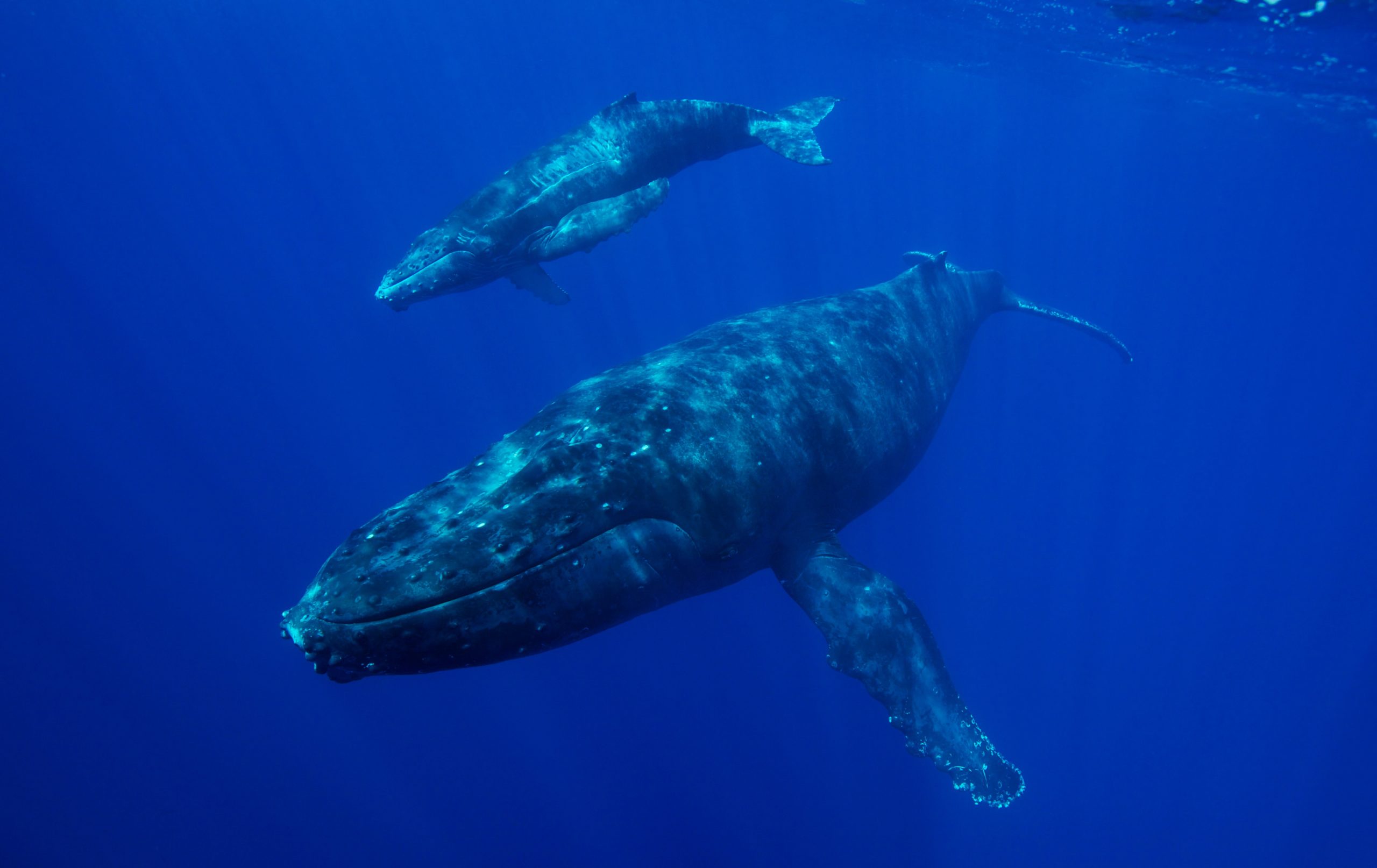
Sea Wonder: Humpback Whale
Humpback whale and calf. Photo: J. Moore/NOAA, under NOAA permit #15240.
The scientific name for humpback whales (Megaptera novaeangliae) means “large-winged” and refers to these whales’ enormous flipper, which grow to be one-third of their full body length. Their common name comes from the distinctive hump positioned directly in front of their dorsal fin. These whales are popular among whale watches due both to their size and high activity levels.
Description
Adult humpback whales can reach sizes of 43 to 52 feet long and weigh up to 80,000 pounds, with females generally growing to be larger than males. Their bodies are mostly black with varying amounts of white on their pectoral fins, bellies, and tail flukes. The amount and placement of white markings varies both by individual genetics and where a population lives. Their tail flukes can reach widths of up to 18 feet and their pectoral fins can grow to be nearly just as long. Since each tail fluke is distinct like our fingerprints, experts can use these features to identify individual animals.
Inside their mouths are baleen plates, made of keratin like our hair and nails, used to filter their prey from sea water. They have one eye on each side of their face, two blowholes atop their head for breathing, and a small dorsal fin about halfway down their back, which is preceded by a small hump.
Diet & Habitat
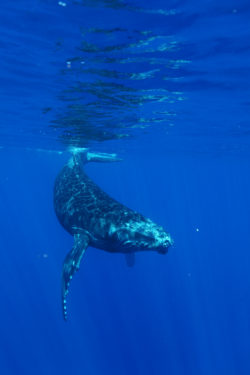
Photo Credit: Ed Lyman/ HIHWNMS NOAA Permit #1524
Three distinct populations exist in the ocean and do not interact with each other, found in the waters of the North Pacific, the North Atlantic, and the Southern Hemisphere. Subpopulations occur in these areas and may or may not interact. The only waters in which we don’t see humpback whales are Arctic waters near the north pole and Mediterranean waters between Africa and Europe.
Humpback whales live in shallow ocean waters and are migratory, so they live in different parts of the ocean depending on the season. While calving, humpback whales prefer warm tropical and subtropical waters, and in the summer, cooler, more temperate areas are better for feeding. We see humpbacks all throughout the National Marine Sanctuary System, including on the West Coast, notably in Channel Islands National Marine Sanctuary and Monterey Bay National Marine Sanctuary, as well as Stellwagen Bank National Marine Sanctuary (in summer) and, not surprisingly, Hawaiian Islands Humpback Whale National Marine Sanctuary (in winter).
Humpback whales, some of the largest animals on earth, rely on some of the smallest to sustain them. Small crustaceans like krill and small fish are common in their diets, but they don’t have much control over what enters their mouth and doesn’t flow back out with the sea water when they use their baleen plates for filtration.
Humpback whales are cooperative feeders, but each group will utilize different feeding strategies depending on where they live. Notable strategies include lunge feeding (swimming through a school of fish, mouth open) and bubble netting, in which whales surround a school of fish and blow bubbles all around them to create a trap before the whales swim to the surface with open mouths. Adult whales can eat as much as 3,000 pounds of food per day in the summer, which helps them build thick fat stores to sustain them during their long migrations and limited food availability in their winter calving habitats.
Life History
Calves are born in tropical or subtropical waters during the winter months and after about a year-long pregnancy. They nurse from their mothers and begin learning to hunt and eat solid food during their migration back to their summer feeding habitats. Mothers can nurse their calves for upwards of a year before weaning them, though calves will continue to grow for about a decade. They can live to be upwards of 80 years old, though the average lifespan seems to be closer to 50.
Humpback whales travel in small pods comprised of a female, her calf, and possibly an escort male. When not migrating, we generally see these whales in larger groups, whether for cooperative feeding or mating behaviors. Humpback whales are quite athletic despite their size and are a favorite among whale watchers due to their frequent breaches, fin slaps, spy hops, and other amazing behaviors.
Humpback whales are famous for their vocalizations, nicknamed “singing”. These vocalizations were first recorded and became famous in 1970 with the release of Songs of the Humpback Whale, an album published by bio-acoustician Dr. Roger Payne. The repertoire of a humpback whale includes moans, howls, cries, and other noises. Males are generally the ones who “sing”. Songs can last as long as 20 minutes and scientists aren’t exactly sure of their purpose, though the songs may be part of what helps males find mates in the open ocean. Whales and dolphins don’t vocalize from their mouths like mammals on land – they instead push air through muscles near their blowholes that they can manipulate to make sound.
Threats & Conservation
Due to historic commercial whaling practices, nearly all humpback whale populations were reduced significantly. A global shift in policies and a 1985 moratorium on commercial whaling helped humpbacks and other large whales to recover. Even so, several distinct populations remain listed as threatened, endangered, or depleted. In the United States, humpback whales are protected under the Marine Mammal Protection Act, with some populations also receiving protection under the Endangered Species Act Today, they face a suite of ongoing pressures including ship strikes, climate-driven changes in prey and habitat, human-generated noise, and habitat degradation, and entanglement in fishing gear and marine debris. Among these threats, entanglement has become an increasing concern.
Entanglements occur when fishing ropes, nets, or marine debris become attached or wrap around a whale as it swims. These incidents can severely restrict movement and lead to serious injury or death. According to NOAA’s 2024 national report on large whale entanglements, the number of cases increased in 2024 and were well above the historical average. Humpback whales continue to be the most frequently entangled species, accounting for 77 of the reported cases. About a quarter of all entanglements occurred off the coast of California, with most concentrated around Monterey Bay.
The Foundation’s Impact
The National Marine Sanctuary Foundation works with a wide range of partners and stakeholders to support efforts that prevent and mitigate whale entanglements in California. This includes partnering with commercial fishermen to support the testing and development innovative fishing gear as well as helping train a network of responders who assist in freeing whales from life-threatening entanglements.
A key part of this work centers on testing pop-up, or on-demand, fishing gear—an innovative approach that removes the need for vertical buoy lines in the water column. Removing these lines significantly reduces the risk of entanglements while still allowing fishing to continue during periods when traditional gear may pose too great a risk. As of June 30, 2025, participating fishermen have carried out 880 trials using six different on-demand systems, generating data and insights that help inform ongoing design improvements and help advance solutions that protect whales while sustaining fishing livelihoods.
When humpback whales in California do become entangled, the West Coast Whale Entanglement Response Network steps in. Without intervention, whales can remain entangled for months or even years. The Foundation supports this effort by helping train the whale rescue responders who work on the water to safely free these animals from entanglement.
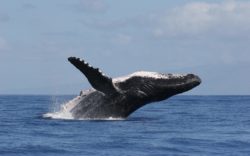
Humpback whale breach in Hawaiian Islands Humpback Whale National Marine Sanctuary. Photo: HIHWNMS/NOAA, under NOAA permit #14097